
In Ayurveda, the dried fruit of Terminalia chebula (Haritaki) has been used for hemorrhoids for centuries. But a long history of use isn’t the same as clinical proof.
This article sorts studies in people from those in rats or cell cultures, and Haritaki alone from multi-herb products. It also covers safety and better-supported options.
What Hemorrhoids Are
Hemorrhoids, also called piles, are swollen and inflamed veins around the anus or in the lower rectum.1 There are two types:
- Internal hemorrhoids form in the lining of the anus and lower rectum. They often show up as painless, bright red blood on the stool, on toilet paper, or in the toilet bowl. They can also bulge out through the anus (prolapse).2
- External hemorrhoids form under the skin around the anus. They can cause itching, tender lumps, and discomfort when sitting.2
They’re common. The National Institute of Diabetes and Digestive and Kidney Diseases (NIDDK) estimates that about 1 in 20 Americans has hemorrhoids, and about half of adults over 50 have them.1 Risk factors include straining during bowel movements, sitting on the toilet for a long time, chronic constipation or diarrhea, a low-fiber diet, pregnancy, and regular heavy lifting.1
Many of these involve hard stools and straining, which is why a reputed gentle laxative like Haritaki seems to fit.
What Is Haritaki?
Haritaki is the Sanskrit name for the dried fruit of Terminalia chebula Retz., a tree native to South and Southeast Asia. Traditional Chinese medicine also uses the fruit, where it is known as Chebulae Fructus. In Ayurvedic practice it has been used for constipation, chronic diarrhea, malabsorption, and hemorrhoids.3
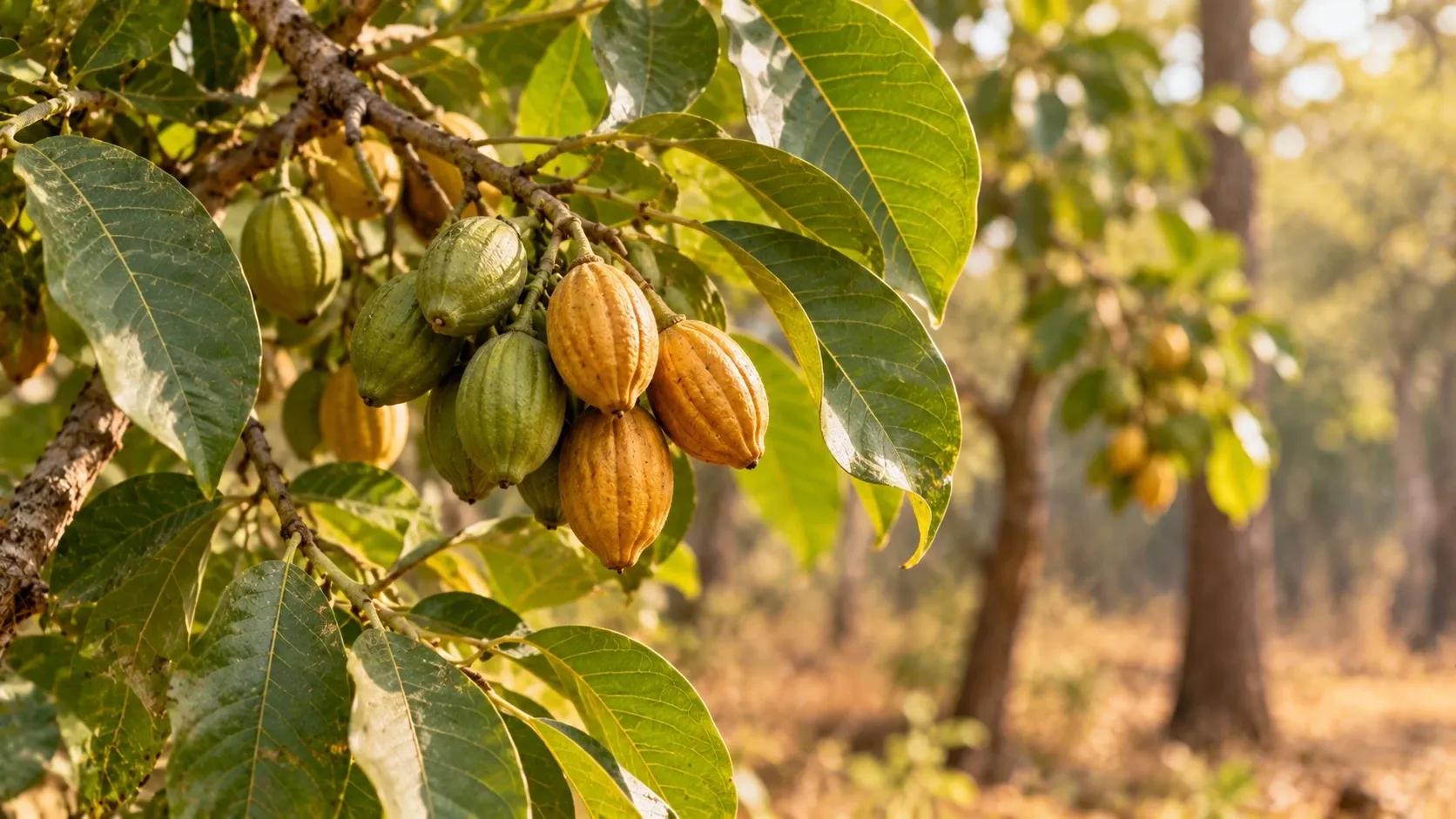
Haritaki is also one of three fruits in Triphala, one of the best-known Ayurvedic formulas. The other two are Amalaki (Emblica officinalis) and Bibhitaki (Terminalia bellerica).4 This matters because many products and studies involve Triphala or larger blends, not Haritaki alone.
Traditional use for Arsha
In classical Ayurvedic texts, hemorrhoids are called Arsha. The chapter on treating Arsha in the Charaka Samhita, a foundational Ayurvedic text, describes several Haritaki preparations. They include Haritaki taken with jaggery before meals, Haritaki soaked overnight, and Abhayarishta, a fermented preparation named after Abhaya, another name for Haritaki.5 The text focuses on improving digestion and keeping bowel movements regular as the core of treatment.5
These texts document tradition, not clinical proof.
How Haritaki Might Work (and How Strong That Evidence Is)
Researchers have identified about 149 compounds in the fruit. They include tannins such as chebulagic acid and chebulinic acid, as well as gallic acid and other phenolic compounds.3 Several possible ways these could affect hemorrhoids have been proposed.
Laxative and stool-softening effect
This is the most plausible link. Softer, easier bowel movements reduce straining, which is a main driver of hemorrhoid symptoms. Ayurvedic sources describe Triphala as a mild laxative at usual doses and a purgative at high doses.4 A 2017 review of Triphala research described a human study that reported less constipation and better stool frequency and consistency.4 However, that evidence applies to the three-fruit formula, not Haritaki alone. Well-controlled studies of Haritaki alone for constipation are scarce.
Anti-inflammatory and antioxidant activity
Haritaki extracts show antioxidant and anti-inflammatory activity in lab studies. These effects appear to involve inflammatory signaling pathways such as NF-κB and MAPK.3 In a 2025 study using human blood-vessel cells and rodent models, a T. chebula fruit extract reduced inflammatory markers, blood-vessel leakiness, and paw swelling.6 These findings make an effect on swollen, inflamed tissue biologically plausible. But they come from cell cultures and animals, not from people with hemorrhoids.
Astringent tannins
Haritaki is rich in tannins, and traditional descriptions credit it with astringent (tissue-tightening) properties that may help with local symptoms.7 The idea that this helps reduce bleeding or swelling in hemorrhoids is mostly traditional reasoning. It hasn’t been measured directly in human trials.
Bottom line on mechanisms: A laxative effect is the most credible pathway. The anti-inflammatory, antioxidant, and astringent effects rest mostly on preclinical data.
What Human Studies Show
This is where the evidence gets thin. A 2025 literature review of natural products for hemorrhoids discussed Haritaki and Triphala in traditional terms. It cited no clinical trials of either one alone, and it concluded that herbal hemorrhoid treatments still need standardization and further clinical trials.7
The one placebo-controlled trial of Haritaki alone
The most relevant study is a double-blind, randomized, placebo-controlled trial published in 2019 in the European Journal of Integrative Medicine.8 Researchers working within the Persian medicine tradition, which also uses T. chebula for hemorrhoids, took these steps:
- They standardized T. chebula and tested it for microbial contamination before making capsules.
- They randomly assigned 104 people with hemorrhoids to T. chebula or placebo capsules, taken four times daily on an empty stomach for four weeks.
- They measured pain, constipation, hemorrhoid size, and bleeding.
The authors reported significantly less pain in the T. chebula group at weeks one and four. They also reported significant differences favoring T. chebula for constipation and hemorrhoid size, and they concluded it may be effective as a supplementary treatment.8
This is a meaningful study, because it used a placebo and blinding and tested Haritaki on its own. Keep its limits in mind, though:
- It is one trial at one site, and no independent group has replicated it.
- It lasted only four weeks, so long-term effects and recurrence rates are unknown.
- The full text is behind a paywall, which limits independent scrutiny of dosing, dropouts, and hemorrhoid grades.
- Its results may not apply to commercial Haritaki products, whose preparation and potency vary.
Studies of multi-herb formulas
Other trials test products that contain Haritaki alongside many other ingredients. One example is a 2015 randomized trial in 90 people with hemorrhoids.9 It compared a seven-day polyherbal kit of tablets, powder, and cream with standard care (psyllium husk plus lidocaine gel) over 14 days. The herbal kit contained more than a dozen botanicals, including Triphala-based ingredients.
- More people in the herbal group reached a symptom score of zero (15 vs. 6).
- Only the evaluator was blinded. Patients knew which treatment they received.
- A herbal products company sponsored the trial and employed one of the authors.9
Even if results like these are real, there is no way to tell which ingredient caused them. Studies of formulas like this say little about Haritaki itself.
Evidence summary
| Type of evidence | What it shows | What it can’t tell you |
|---|---|---|
| Traditional texts (Charaka Samhita) | Long-standing use of Haritaki preparations for Arsha5 | Whether it works, or at what dose |
| Cell and animal studies | Anti-inflammatory, antioxidant, and anti-swelling activity3,6 | Whether these effects occur in human hemorrhoidal tissue |
| One RCT of T. chebula alone (n = 104, 4 weeks) | Improvements in pain, constipation, and size vs. placebo8 | Long-term benefit, safety, or whether results can be reproduced |
| Trials of polyherbal formulas | Symptom improvement vs. conventional care in small, partly blinded studies9 | Which ingredient, if any, is responsible |
What’s Missing From the Research
Before Haritaki could be recommended with confidence, researchers would need:
- Replication. Larger, independent, multicenter trials of Haritaki alone.
- Standardized products. Consistent extraction, dosing, and tannin content so results can be compared.
- Hemorrhoid grading. Results reported by hemorrhoid grade, since mild internal hemorrhoids and prolapsed ones behave very differently.
- Head-to-head comparisons. Trials against fiber supplements, the established first-line option.
- Longer follow-up. Data on recurrence and long-term safety.
- Human safety data. Pharmacokinetic and drug interaction studies in people, which are currently lacking.3
Safety, Side Effects, and Who Should Avoid It
In short-term rodent studies, Haritaki extracts have shown low acute toxicity. However, one study found weight loss and mild liver and kidney changes in rats given high doses for 28 days. The 2024 review noted that thorough safety evaluations are still lacking.3
Possible side effects
Because a key effect of Haritaki is laxative, the most predictable side effects are digestive: loose stools, cramping, or diarrhea, especially at higher doses.4 This is worth taking seriously. Chronic diarrhea is itself a risk factor for hemorrhoids.1
Possible drug interactions
In rats, chebulinic acid, a Haritaki compound, changed the activity of several cytochrome P450 enzymes, which the liver uses to process many medications. The authors warned this could affect how other drugs are metabolized.3 No human interaction studies are available. A laxative effect can also change how well oral medications are absorbed.
Who should be cautious or avoid it
- People who are pregnant or breastfeeding. No safety data exist. NCCIH advises consulting a health care provider, because some Ayurvedic products may contain harmful substances.10
- People with diarrhea, dehydration, or inflammatory bowel disease. A laxative could make these conditions worse.
- People taking regular medications, particularly drugs with a narrow therapeutic range. Check with a pharmacist first.
- Children, unless a qualified clinician is supervising.
Product quality concerns
Ayurvedic products are not tightly regulated in the United States.10 A 2008 JAMA study tested 193 Ayurvedic products bought online and found that about one in five contained detectable lead, mercury, or arsenic. This was true of both US-made and Indian-made products.11 Rates were highest in rasa shastra formulas, which deliberately combine herbs with metals or minerals. If you choose to use Haritaki, a single-ingredient product with independent third-party testing lowers, but doesn’t remove, this risk.
Evidence-Based First-Line Approaches
For most people with mild to moderate hemorrhoids, the best-supported options are simple and inexpensive.
- More fiber. A meta-analysis of seven randomized trials with 378 participants found that fiber cut the risk of persistent symptoms by about 47% and the risk of bleeding by about 50%.12 Food sources and supplements such as psyllium or methylcellulose both count.13
- Enough fluids. Drinking water and other nonalcoholic liquids helps fiber work.13
- Better toilet habits. Avoid straining and don’t sit on the toilet for long periods.13
- Warm sitz baths. Sitting in warm water several times a day can ease pain.13
- Short-term over-the-counter relief. Pain relievers and hemorrhoid creams or suppositories can help, usually for up to one week.13
The American Society of Colon and Rectal Surgeons’ 2024 guideline agrees. It names enough fluid and fiber, plus counseling on bowel habits, as first-line therapy for symptomatic hemorrhoids.14 If you’re considering Haritaki, it would make sense as an addition to these measures, not a replacement for them.
When to See a Doctor
Not every anal symptom is a hemorrhoid. Rectal bleeding can also come from Crohn’s disease, ulcerative colitis, or colorectal cancer.2 Before relying on any herbal remedy, see a health care professional if:
- You have any rectal bleeding, especially if it’s new, you’re over 45, or you have a family history of colorectal cancer.
- Your stools are dark, maroon, or tarry, or your bowel habits have changed.
- Symptoms don’t improve after about one week of home treatment.13
Get care right away for severe anal pain with rectal bleeding, particularly if you also have abdominal pain, diarrhea, or fever.13 Guidelines note that some people with hemorrhoids and rectal bleeding need a full colonoscopy to rule out other causes.14
The Bottom Line
Haritaki has a long traditional record of use for hemorrhoids and a plausible way of helping, mainly by softening stool and reducing straining. Lab and animal studies suggest anti-inflammatory effects. But human evidence for Haritaki alone comes down to one four-week placebo-controlled trial of 104 people. Its results are encouraging but have not been replicated.
Studies of multi-herb formulas can’t isolate Haritaki’s role. Fiber, fluids, and good bowel habits have much stronger evidence. Anyone thinking about trying Haritaki should talk with a clinician first, especially if they’re pregnant, have diarrhea, take regular medication, or have any rectal bleeding.
This article is for informational purposes only and is not a substitute for professional medical advice, diagnosis, or treatment.